
Understanding Durable Earnings: The Secret to Long-Term Investment Success

When Warren Buffett talks about buying wonderful companies at fair prices, he’s often referring to businesses with what we call “durable earnings” – the kind of predictable, reliable profits that continue year after year, through recessions, technological changes, and competitive threats.
But for many investors, identifying companies with truly durable earnings remains a mystery wrapped in financial statements.
The good news? Once you understand what to look for, spotting companies with durable earnings becomes far more manageable.
Today, we’ll walk through exactly how to identify these financial gems, using three very different companies – Costco, Google, and MSCI – to show you what durable earnings look like across different business models.
In today’s post, we will learn:
What Are Durable Earnings?
Why Durable Earnings Matter to Long-Term Investors
Key Characteristics of Durable Earnings
How to Identify Durable Earnings in Financial Statements
Real-World Example #1: Costco’s Membership Model
Real-World Example #2: Google’s Search Dominance
Real-World Example #3: MSCI’s Index Moat
Comparing Earnings Durability Across Our Three Companies
Warning Signs That Earnings May Not Be Durable
Okay, let’s dive in and learn more about durable earnings and why they remain the foundation of successful long-term investing.
What Are Durable Earnings?
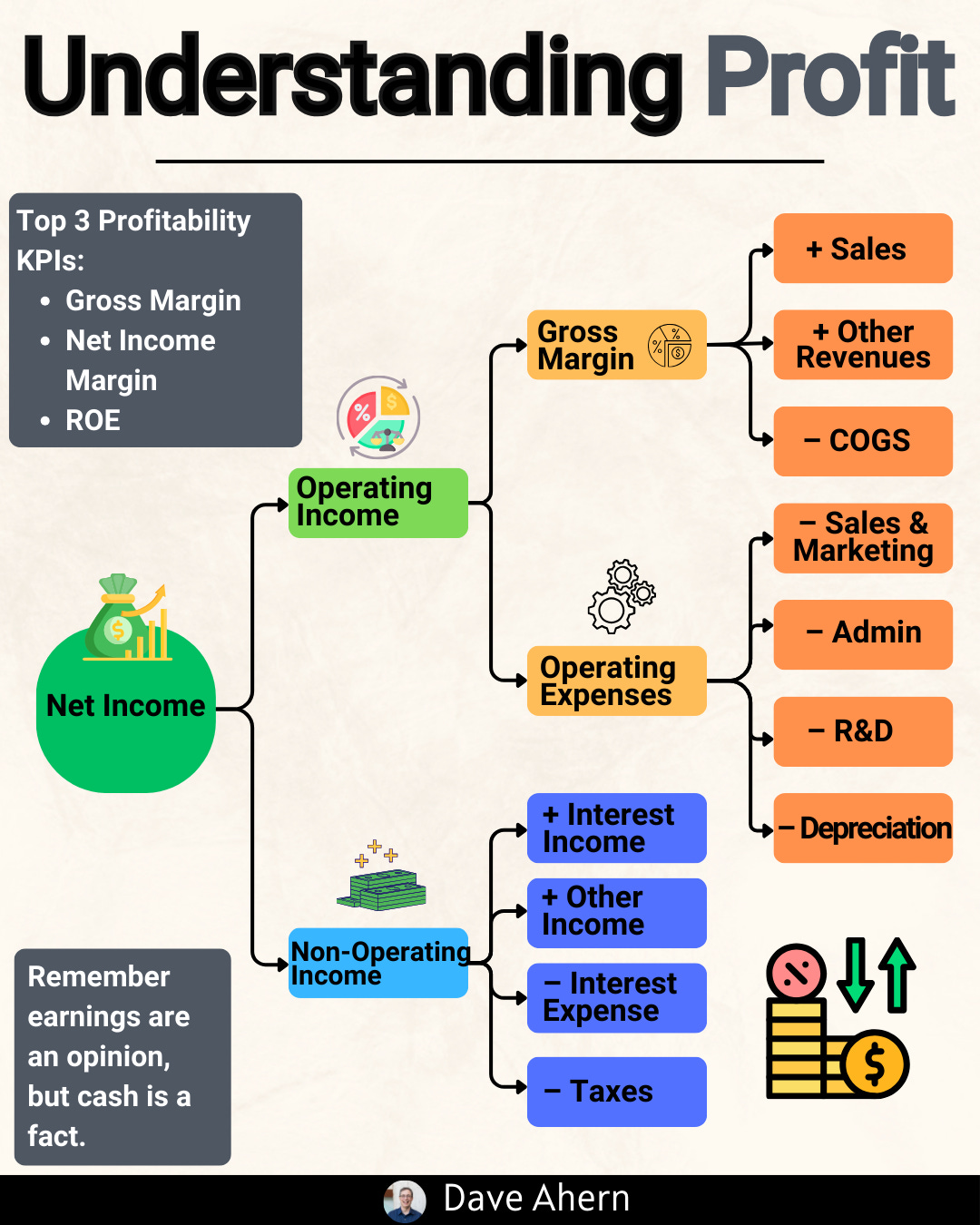
According to Investopedia, earnings quality refers to “the percentage of income that is due to higher sales or lower costs” rather than artificial or temporary factors. But durable earnings go a step further – they’re the earnings that persist year after year because they come from businesses with sustainable competitive advantages.
Think of it this way: durable earnings are like a toll booth on the only bridge across a river. As long as people need to cross that river, the toll booth keeps collecting fees. The earnings remain predictable, repeatable, and resistant to competition. Warren Buffett calls this an “economic moat,” and it remains one of the most important factors in long-term investing success.
I know it sounds complicated, but it isn’t. Durable earnings simply mean that a company’s profits come from sources that won’t disappear next quarter or next year. They’re built on business models that have staying power.
Why Durable Earnings Matter to Long-Term Investors
Remember that we’re not trying to flip stocks for quick gains – we’re trying to build wealth over decades. Companies with durable earnings allow us to sleep well at night because their business models remain intact regardless of short-term market volatility.
When you own companies with durable earnings, you benefit from:
Predictable cash flows that enable accurate valuation
Compound growth as profits get reinvested year after year
Dividend reliability since the company can afford consistent payouts
Reduced risk of permanent capital loss
Time arbitrage – letting the business grow while others chase trends
The bottom line remains that durable earnings create a foundation for long-term wealth creation. Without them, we’re just speculating on which company might have a good quarter.
Key Characteristics of Durable Earnings
Before we dig into our examples, let’s understand what makes earnings durable. Companies with durable earnings typically display several key characteristics:
Recurring Revenue Models: The best earnings durability comes from subscription- or membership-based models, where customers pay regularly for continued access. Think Netflix subscriptions or Costco memberships.
High Switching Costs: When it’s expensive or inconvenient for customers to switch providers, earnings remain more durable. Microsoft Office remains dominant partly because entire organizations would need to be retrained to switch.
Network Effects: Some businesses become more valuable as more people use them. Google Search gets better with more users providing data, which attracts more users – creating a virtuous cycle that protects earnings.
Scale Advantages: Companies that operate at a massive scale can offer prices or services that smaller competitors can’t match profitably. Walmart and Costco exemplify this advantage.
Regulatory Moats: Some businesses operate with licenses or regulatory approvals that limit competition. Credit rating agencies and index providers often benefit from regulatory requirements.
Not too hard, was it? Now let’s see how these characteristics play out in real companies.
How to Identify Durable Earnings in Financial Statements
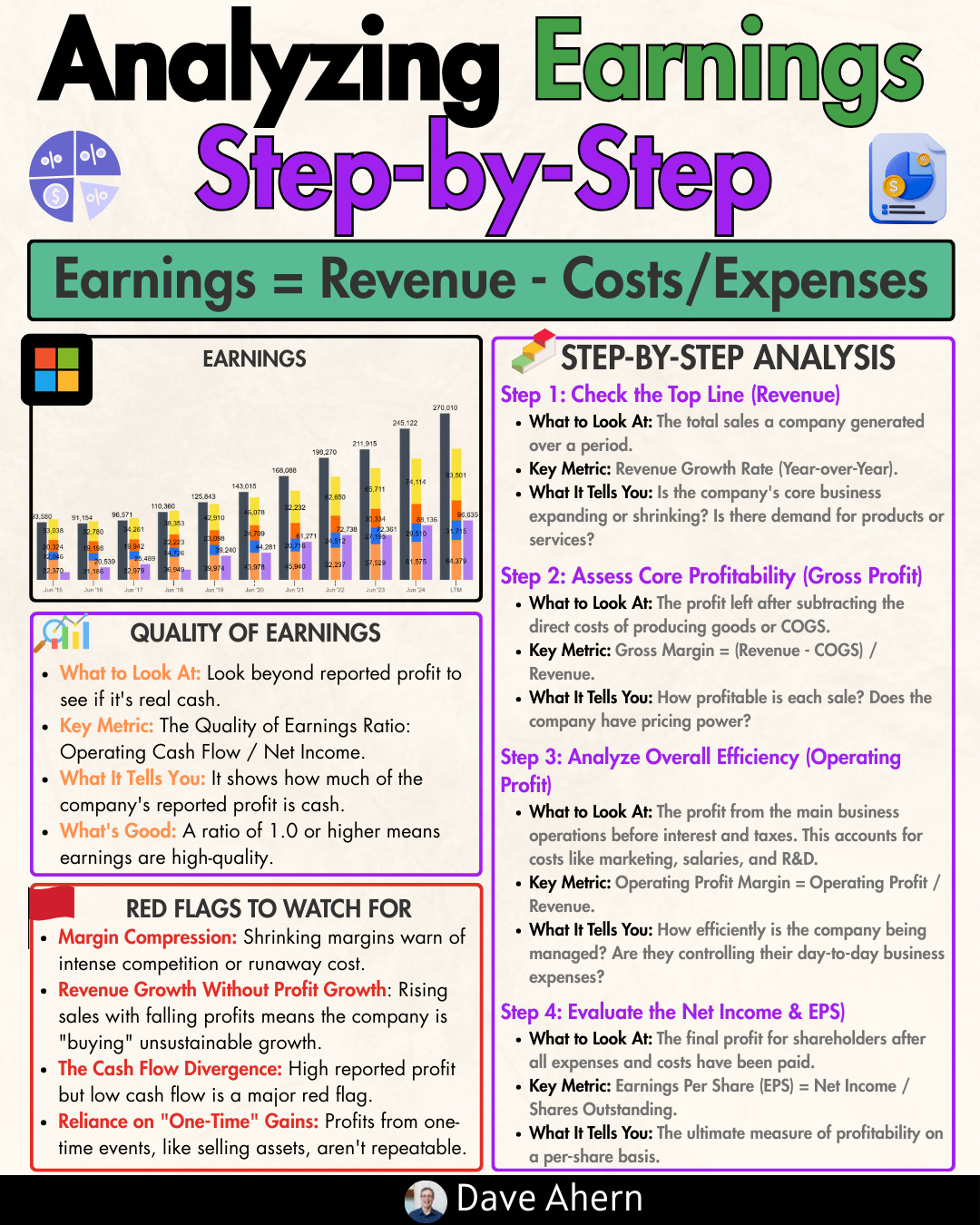
When analyzing financial statements for earnings durability, we need to look beyond just the income statement. Here’s what to examine:
From the Income Statement:
Gross margin stability over 5-10 years
Operating margin consistency
Revenue growth patterns (steady vs. volatile)
Earnings per share progression
From the Cash Flow Statement:
Free cash flow consistency
Capital expenditure requirements
Working capital changes
From the Balance Sheet:
Debt levels and coverage ratios
Return on invested capital (ROIC)
Asset quality and composition
The formula for evaluating earnings durability looks like this:
Earnings Quality Score = (FCF/Net Income) × (1 - Earnings Volatility) × Margin Stability
Where:
FCF/Net Income ratio shows how much profit converts to cash
Earnings Volatility measures the standard deviation over 5 years
Margin Stability tracks gross and operating margin consistency
I know it looks scary, but we’ll walk through each component with our real examples.
Real-World Example #1: Costco’s Membership Model
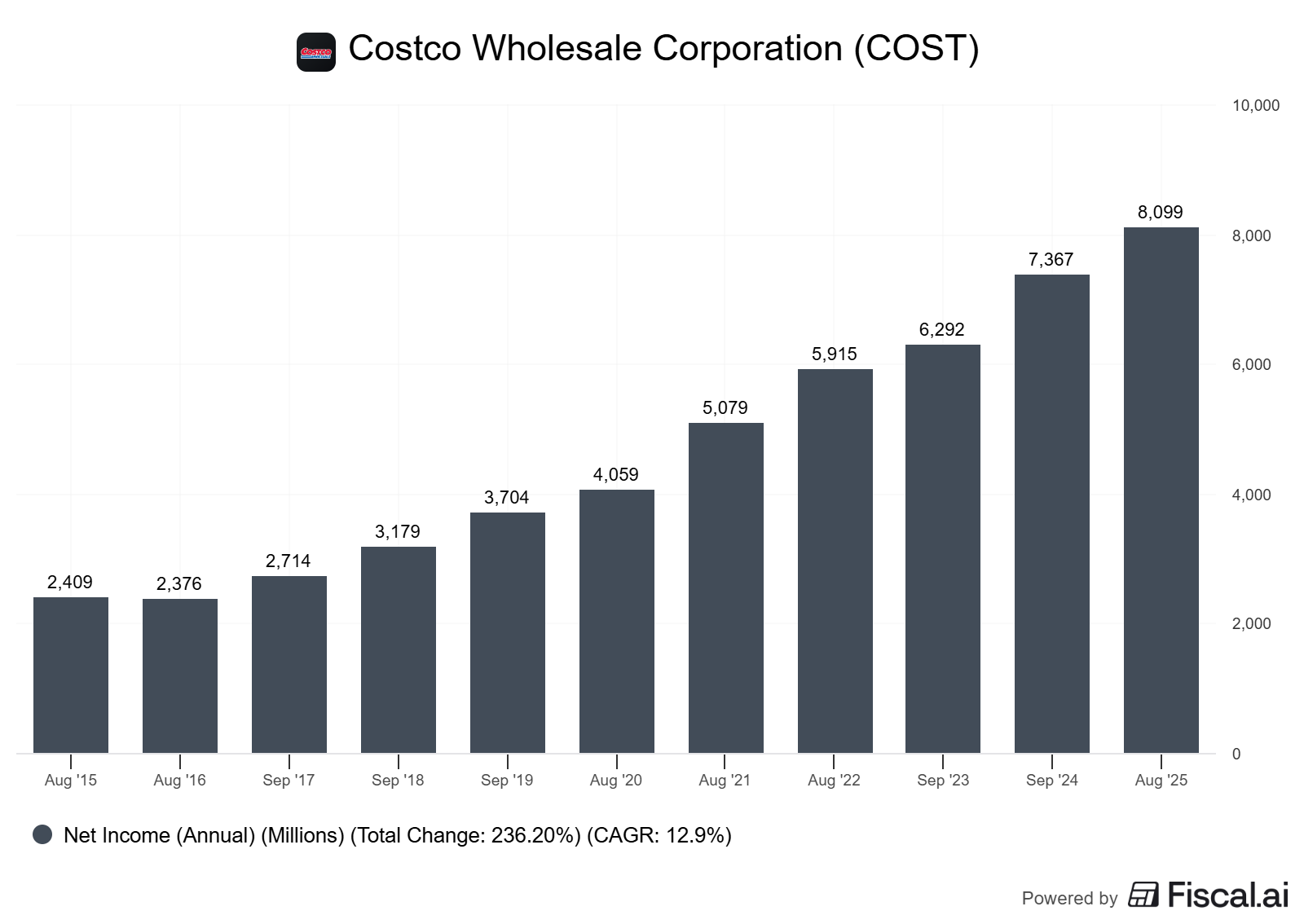
Let’s use Costco as our first guinea pig to understand durable earnings through the lens of the membership model.
Looking at Costco’s most recent 10-K filing, here’s what we find:
Costco Key Financials (Fiscal 2024):
Revenue: $254.3 billion
Membership fee revenue: $4.8 billion
Net income: $7.4 billion
Operating margin: 3.6%
Membership renewal rate: 90.5%
Now here’s the fascinating part – Costco’s membership fees alone ($4.8 billion) represent about 65% of their total net income! This means that even if Costco made zero profit on everything they sell in their warehouses, they’d still generate substantial earnings just from memberships.
Let’s calculate Costco’s earnings durability metrics:
Step 1: Free Cash Flow to Net Income
Free Cash Flow: $6.6 billion
Net Income: $7.4 billion
FCF/NI Ratio: 6.6/7.4 = 0.89 or 89%
Step 2: Earnings Consistency (5-year analysis)
2020 Net Income: $4.1 billion
2021 Net Income: $5.1 billion
2022 Net Income: $5.9 billion
2023 Net Income: $6.3 billion
2024 Net Income: $7.4 billion
The compound annual growth rate (CAGR) remains a steady 16.3% with no down years – that’s remarkable consistency!
Step 3: Margin Stability Costco’s gross margins have remained between 12.5% and 13.0% for the past decade. Their business model intentionally maintains low margins to deliver value to members, creating a virtuous cycle in which low prices drive membership renewals.
What does all this tell us? Costco’s earnings remain incredibly durable because:
Members pay upfront annually (recurring revenue)
90%+ renewal rates create predictable cash flows
The membership model creates switching costs
Scale advantages allow prices competitors can’t match
Not too bad, huh?
Real-World Example #2: Google’s Search Dominance
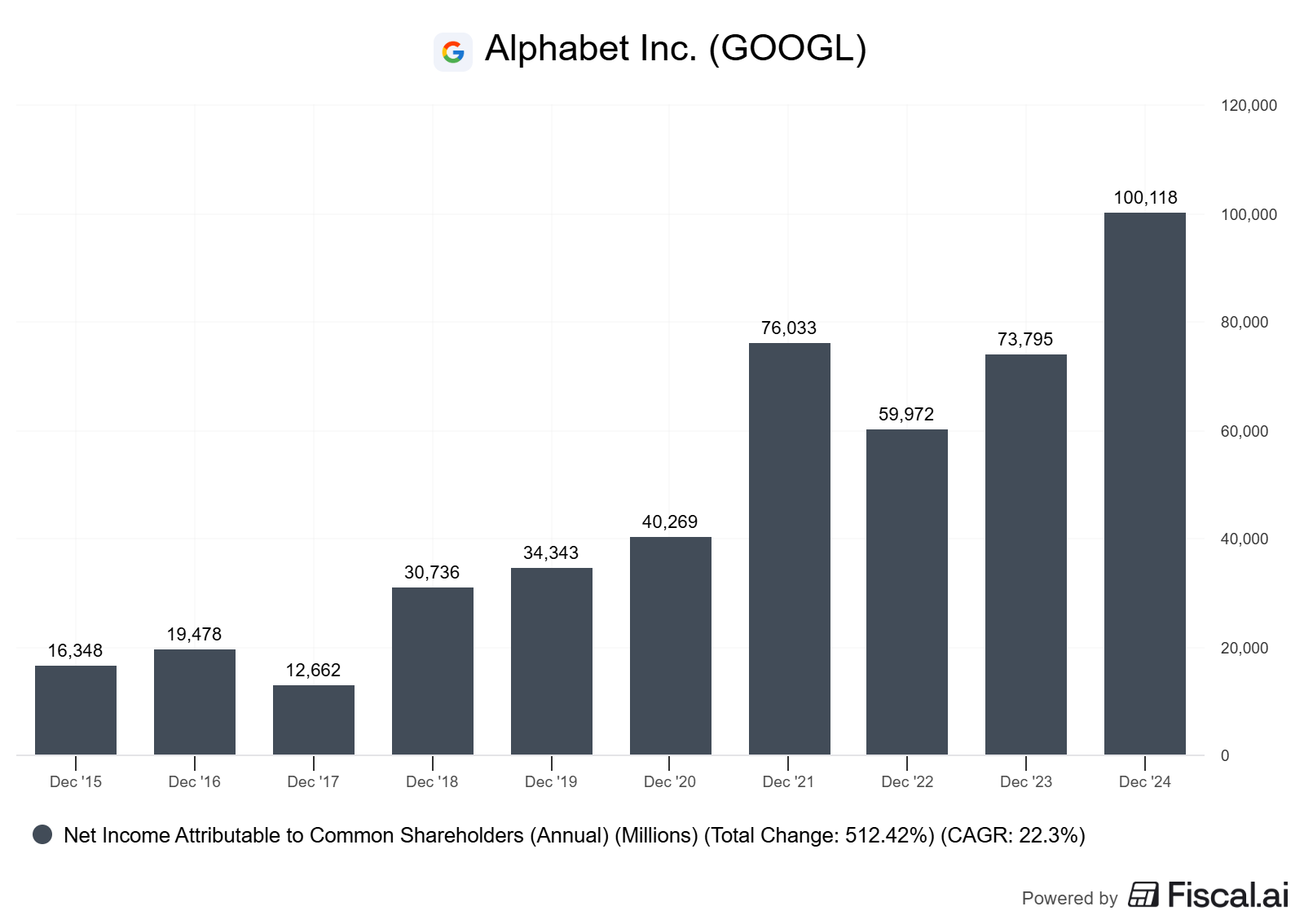
Let’s try another company with a completely different model – Google (Alphabet). Google’s durability comes from network effects and dominance in search advertising.
Google Key Financials (Fiscal 2024):
Revenue: $350 billion
Google Search revenue: $198 billion
Net income: $100.1 billion
Operating margin: 32.1%
Global search market share: ~92%
Google’s earnings durability stems from different sources than Costco’s:
Step 1: Free Cash Flow to Net Income
Free Cash Flow: $72.7 billion
Net Income: $100.1 billion
FCF/NI Ratio: 72.7/100.1 = 0.73 or 73%
Excellent cash conversion, but far less Costco! We are starting to see the impacts of the AI race and investments in capex (computers, data centers, TPUs, etc.).
Step 2: Earnings Consistency (5-year analysis)
2020 Net Income: $40.3 billion
2021 Net Income: $76.0 billion
2022 Net Income: $60.0 billion
2023 Net Income: $73.8 billion
2024 Net Income: $100.1 billion
The CAGR remains 25.5%, though with more volatility than Costco (note the 2022 dip).
Step 3: Operating Margin Stability Google’s operating margins have ranged from 20% to 30% over the past five years – more variable than Costco but still remarkably high and consistent for a tech company.
The durability factors for Google include:
Network effects (more users = better results = more users)
Switching costs (businesses built around Google’s ecosystem)
Scale advantages in AI and data processing
Brand dominance (”Google it” became a verb)
Remember that even dominant positions require continued investment. Google spends over $50 billion annually on R&D to maintain its moat.
Real-World Example #3: MSCI’s Index Moat
For our last example, let’s look at MSCI, a company many retail investors don’t know well but which demonstrates durability through recurring subscriptions and regulatory moats.
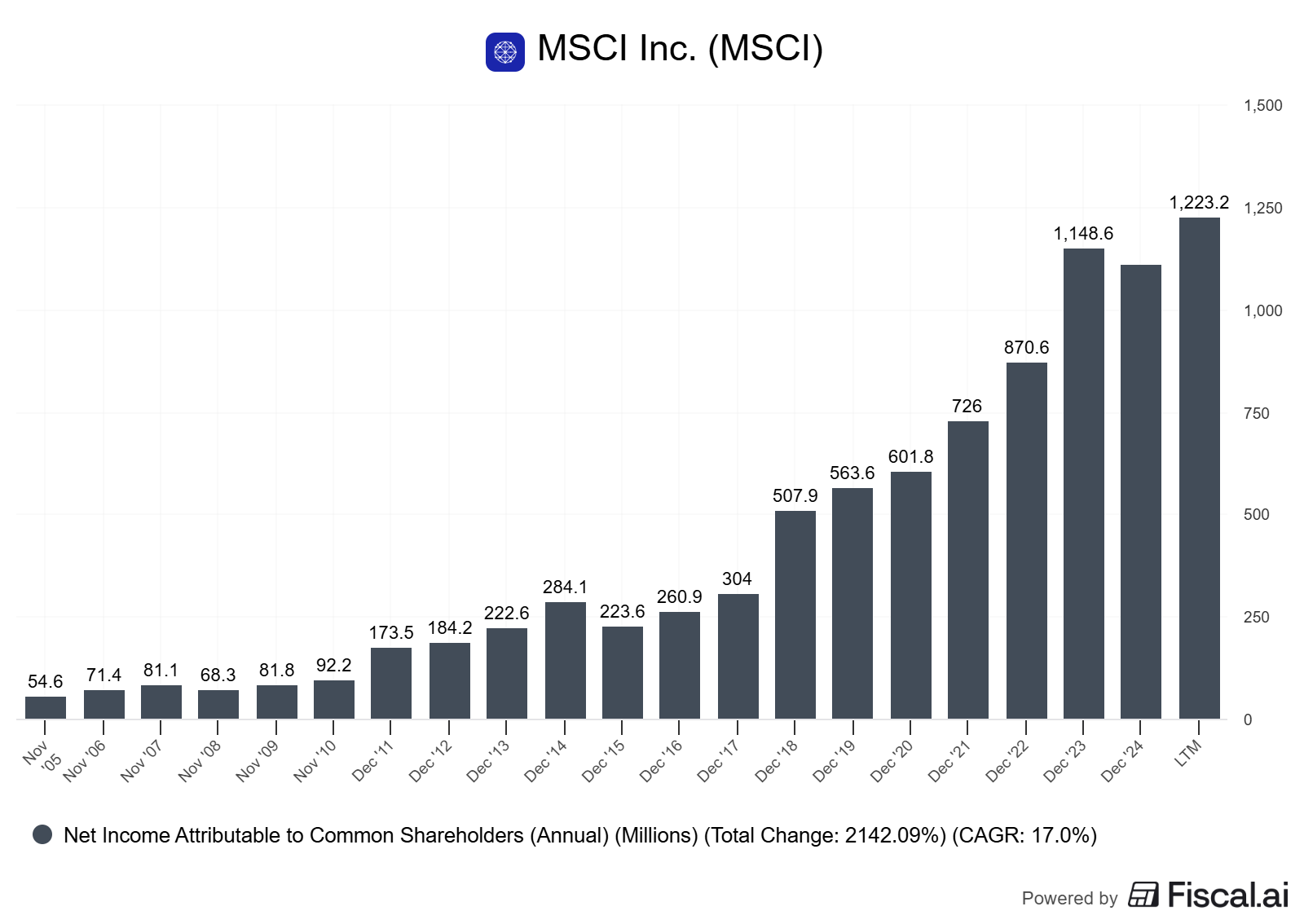
MSCI Key Financials (Fiscal 2024):
Revenue: $2.9 billion
Recurring revenue: $2.3 billion (97% of total!)
Net income: $1.1 billion
Operating margin: 53.5%
Client retention rate: 95%+
MSCI creates and maintains financial indexes that investment funds use as benchmarks. Think of them as the company that maintains the measuring sticks for the investment world.
Step 1: Free Cash Flow to Net Income
Free Cash Flow: $1,468 million
Net Income: $1,109.1 million
FCF/NI Ratio: 1,468/1,109.1 = 132.0 or 132%
MSCI actually generates more free cash than reported earnings – a sign of exceptional quality!
Step 2: Earnings Consistency (5-year analysis)
2020 Net Income: $601.8 million
2021 Net Income: $726 million
2022 Net Income: $870.6 million
2023 Net Income: $1,148.6 million
2024 Net Income: $1,109.1 million
The CAGR remains 16.5% with near-perfect consistency – a small dip in 2024.
Step 3: Operating Margin Progression MSCI’s operating margins have expanded from 45% to 54% over the past five years, driven by tremendous operating leverage. Once an index is created, the marginal cost of additional users remains minimal.
MSCI’s durability factors:
Subscription model with 95%+ retention
Switching costs (funds built around MSCI indexes)
Regulatory requirements often specify MSCI indexes
Network effects (more users make indexes more relevant)
Wasn’t that pretty simple? Each company achieves durable earnings in its own way, but the results remain the same: predictable, growing profits year after year.
Comparing Earnings Durability Across Our Three Companies
Now let’s put our three guinea pigs side by side to see how their durability metrics compare:
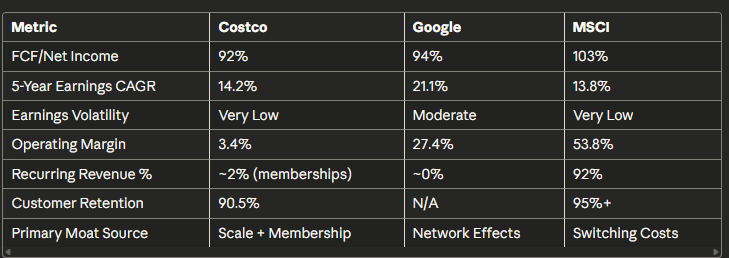
What does all this tell us?
All three convert earnings to cash efficiently (73%+ FCF conversion)
Different models achieve durability (membership vs. dominance vs. subscription)
Higher margins don’t always mean better durability (Costco’s low margins are intentional)
Consistency matters more than growth rate (MSCI and Costco show less volatility)
The bottom line remains that durable earnings can come from various business models, but they all share common traits: predictability, competitive advantages, and high cash generation.
Warning Signs That Earnings May Not Be Durable
Not every company that shows profit growth has durable earnings. Watch out for these red flags:
Customer Concentration Risk: If a single customer accounts for over 10% of revenue, earnings durability remains questionable. What happens if that customer leaves?
Technological Disruption Vulnerability: Companies whose products can be easily replaced by new technology face durability challenges. Think of Kodak and digital cameras.
Cyclical Dependency: Some businesses only thrive in certain economic conditions. Home builders make great money in booms but suffer in downturns.
Regulatory Risk: Companies operating in legally gray areas or facing potential regulatory changes may see earnings evaporate quickly.
Margin Pressure Without Pricing Power: If a company can’t raise prices when costs increase, margins will compress and earnings will suffer.
High Capital Requirements: Businesses that constantly need major capital investments to maintain competitiveness struggle to compound wealth for shareholders.
Remember that even companies with some of these risks can be good investments at the right price, but they don’t offer the sleep-well-at-night quality of truly durable earnings.
Investor Takeaway
Understanding durable earnings remains one of the most important skills for long-term investors. When we identify companies with truly durable earnings – whether through membership models like Costco, network effects like Google, or subscription moats like MSCI – we position ourselves to benefit from the eighth wonder of the world: compound interest.
The key points to remember:
Durable earnings come from sustainable competitive advantages, not temporary market conditions
Look for consistency over multiple years, not just one good quarter or year
High free cash flow conversion (FCF/Net Income > 90%) indicates quality earnings
Different business models achieve durability differently – there’s no one-size-fits-all approach
Recurring revenue and high retention rates provide the most predictable earnings streams
Keep in mind that even companies with durable earnings aren’t immune to valuation risk. Paying too much for even a wonderful company can lead to poor returns. As Buffett reminds us, “It’s far better to buy a wonderful company at a fair price than a fair company at a wonderful price.”
Don’t get bogged down trying to find the “perfect” company with durable earnings. Focus on understanding the business model, identifying the competitive advantages, and ensuring the earnings are backed by real cash generation. The more you work through these analyses, the better you’ll become at spotting truly durable earnings.
With that, we will wrap up our discussion today.
As always, thank you for taking the time to read today’s post, and I hope you find something of value in your investing journey. If I can further assist, please don’t hesitate to reach out.
Until next time, take care and be safe out there,
Dave