
Essential Tools for Better Fundamental Analysis: A Due Diligence Checklist for Investors

Finding great companies to invest in remains one of the most important skills any investor can develop. But I know what you’re thinking – analyzing financial statements feels overwhelming, especially when you’re staring at a 200-page 10-K filing. (Hello JP Morgan)
The good news? We now have tools that make fundamental analysis far more accessible than ever before. These tools help us dig deeper, work faster, and uncover insights we might miss if we’re just skimming Yahoo Finance.
In today’s post, we will learn:
Okay, let’s dive in and learn more about building a better fundamental analysis toolkit.
What is Fundamental Analysis Due Diligence?
Before we jump into the tools, let’s talk about what we’re actually trying to accomplish.
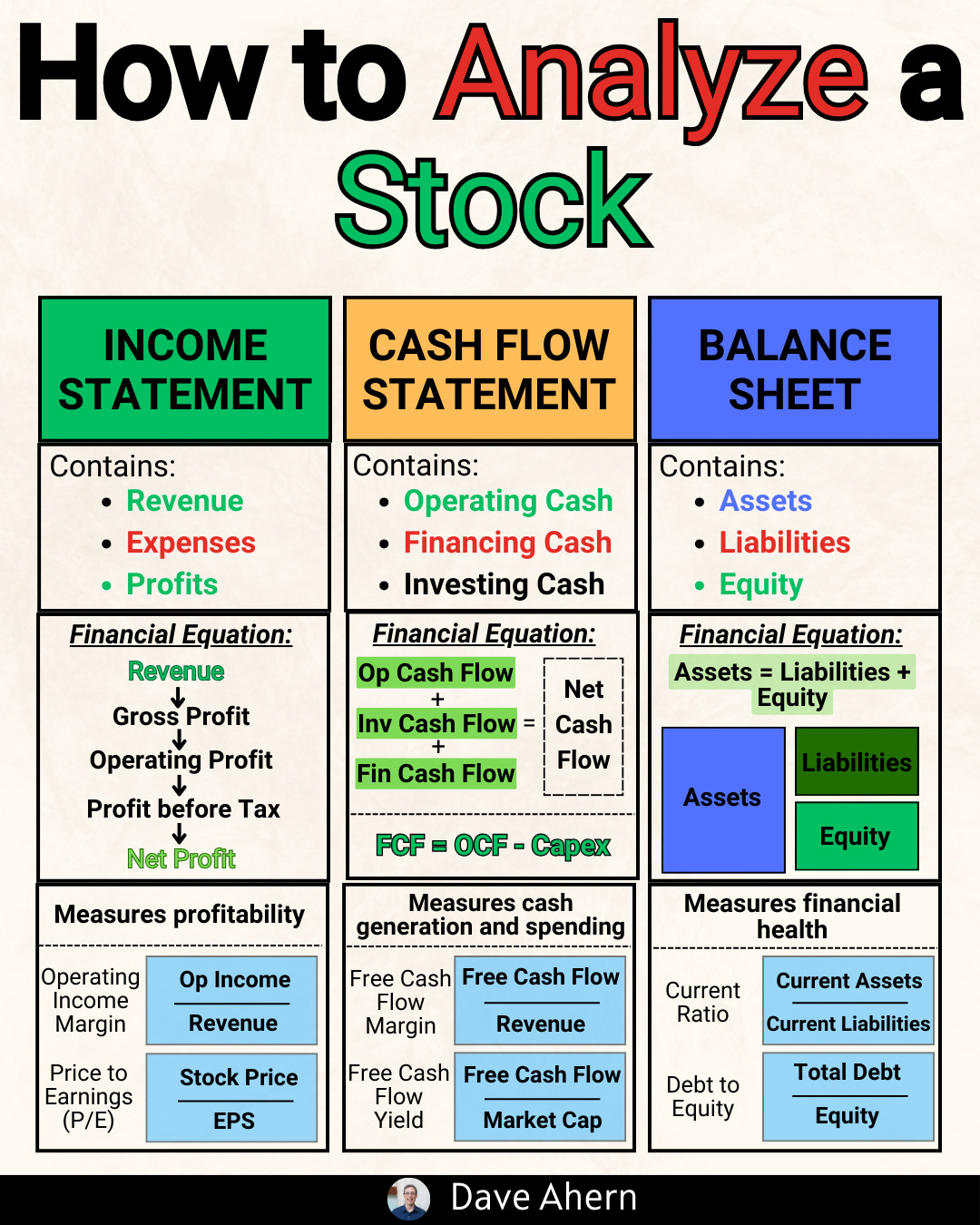
Fundamental analysis remains the process of evaluating a company’s financial health, business quality, and competitive position to determine if it’s worth owning. Due diligence is the systematic checklist we use to make sure we’re not missing anything important.
Think of it this way: when you’re buying a house, you don’t just look at the listing photos on Zillow. You hire an inspector, check the foundation, test the plumbing, and review the neighborhood comps. Investing in a company requires the same level of scrutiny.
The challenge? Most beginning investors stop at the equivalent of those Zillow photos – they check the P/E ratio on Yahoo Finance, read a couple news articles, and call it research. I know because that’s exactly what I did when I started!
The tools we’ll discuss today help you conduct real due diligence without needing an MBA or a Bloomberg terminal.
The Complete Due Diligence Checklist
Let’s start by building a comprehensive checklist. This remains our roadmap for analyzing any company, and the tools we’ll discuss help us complete each section efficiently.
Here’s what a thorough fundamental analysis should cover:
Business Quality (20% of checklist)
What does the company actually do?
Who are the customers?
What is the competitive advantage (moat)?
Is the industry growing or declining?
Financial Health (30% of checklist)
Revenue growth trends (3-5 years)
Profitability metrics (gross margin, operating margin, net margin)
Cash flow generation (operating cash flow, free cash flow)
Balance sheet strength (debt levels, current ratio)
Return on invested capital (ROIC)
Management Quality (15% of checklist)
Track record of capital allocation
Insider ownership and recent buying/selling
Compensation structure alignment
Tone and transparency in earnings calls
Valuation (20% of checklist)
Current multiples (P/E, P/S, P/FCF, EV/EBITDA)
Historical valuation ranges
Peer comparison
DCF or other intrinsic value estimates
Risks & Red Flags (15% of checklist)
Regulatory concerns
Competitive threats
Customer concentration
Accounting irregularities
Litigation or controversies
Not too bad, huh? Now let’s see how each tool helps us check these boxes.
Tool #1: Fiscal.ai – Your Financial Statement Workbench
What it is: Fiscal.ai is a financial data platform that turns SEC filings into interactive, analyzable spreadsheets. Think of it as Excel meeting the SEC’s EDGAR database.
Why it matters: Reading financial statements in 10-K format remains tedious. Numbers are scattered across different sections, formats vary by company, and calculations require manually pulling data into Excel. Fiscal.ai solves this by automatically extracting, standardizing, and organizing all the numbers.
What it helps you check:
✓ Revenue growth trends
✓ Profitability metrics
✓ Cash flow generation
✓ Balance sheet strength
✓ Historical valuation ranges
How to use it for Zoetis:
Let’s use Zoetis (ticker: ZTS), the world’s leading animal health company, as our guinea pig. Zoetis develops medicines, vaccines, and diagnostics for pets and livestock.
When you pull up Zoetis in Fiscal.ai, you immediately see the last 5-10 years of financial statements in a clean, spreadsheet format. No more hunting through PDF files!
Here’s what we can quickly extract from their 2024 10-K:
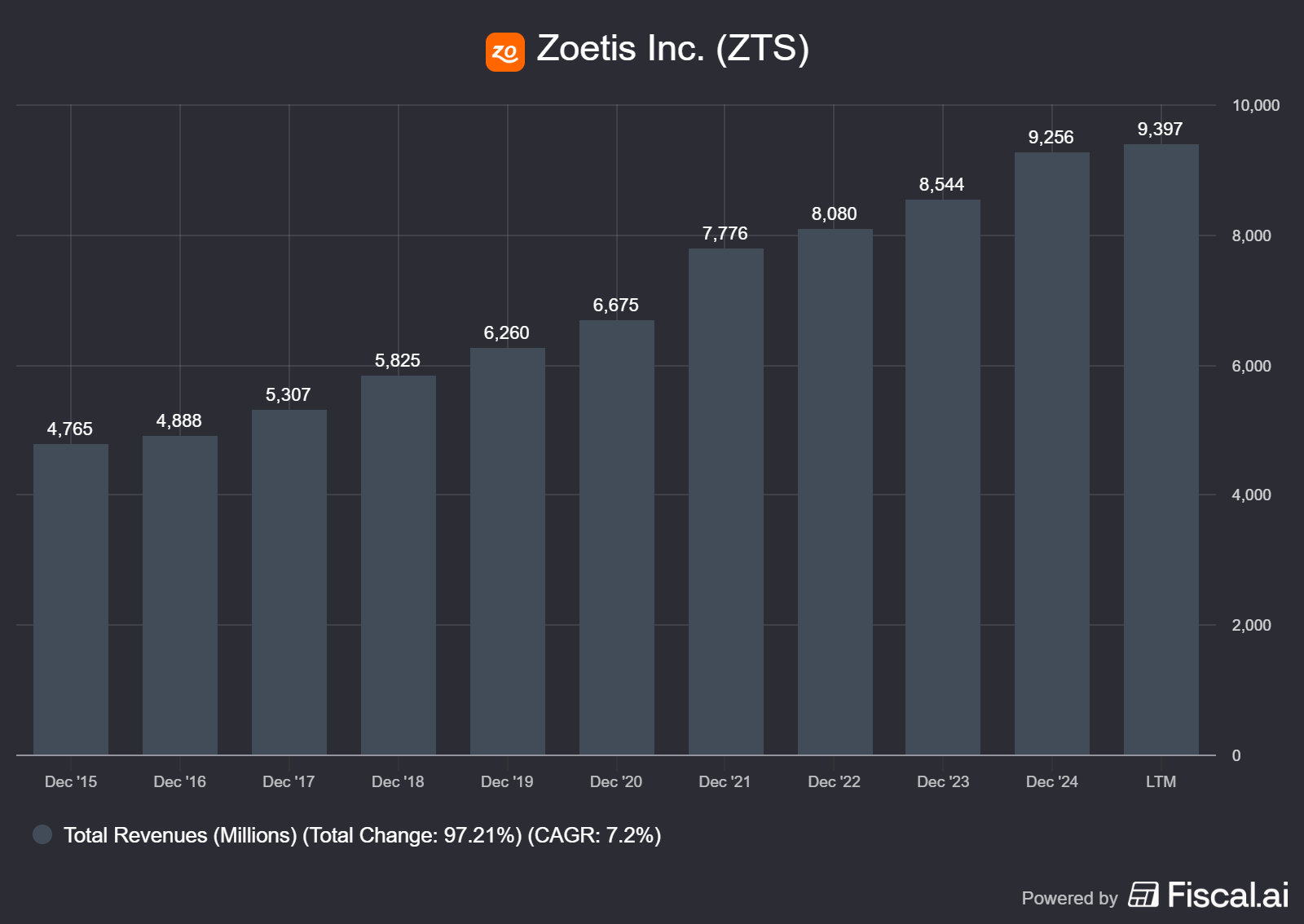
Revenue Trends: Using Fiscal.ai, we see:
2022: $8,080 million
2023: $8,544 million
2024: $9,256 million
That’s growth of 6% in 2023 and 8% in 2024 – steady and consistent. Fiscal.ai lets us chart this instantly to visualize the trend.
Profitability:
2024 Net Income: $2,486 million
2024 Net Margin: 26.9% ($2,486 / $9,256)
A net margin approaching 27% remains impressive. This tells us Zoetis operates a profitable business model.
Cash Flow:
2024 Operating Cash Flow: $2,953 million
2024 Capital Expenditures: $655 million
2024 Free Cash Flow: $2,298 million ($2,953 - $655)
The company generated $2.3 billion in free cash flow – money available for dividends, buybacks, or acquisitions. That’s strong.
The beauty of Fiscal.ai? All these calculations happen automatically. You can export the data, build custom charts, and compare against peers without manually typing numbers into Excel.
Pro tip: Use Fiscal.ai to quickly identify trends. If revenue growth is accelerating, that’s interesting. If margins are declining, that’s a yellow flag requiring investigation.
Tool #2: Bamsec – Deep Dive Search Engine
What it is: Bamsec is a specialized search engine for SEC filings. It’s like Google, but exclusively for 10-Ks, 10-Qs, 8-Ks, and other regulatory documents.
Why it matters: Sometimes you need to find specific information buried in hundreds of pages of filings. Bamsec lets you search across years of documents to find references to products, competitors, lawsuits, or accounting changes.
What it helps you check:
✓ Competitive threats
✓ Regulatory concerns
✓ Customer concentration
✓ Litigation or controversies
✓ Accounting changes or irregularities
How to use it for Zoetis:
Let’s say we want to understand Zoetis’s competitive position. We could search for mentions of “competition” or specific competitor names across their filings.
Using Bamsec, we might search: “Zoetis + Elanco” (a major competitor) to see how often they’re mentioned together and in what context.
We could also search for risk factors: “Zoetis + patent expiration” to understand which products face generic competition.
Here’s a practical example: When analyzing Zoetis, you might want to know about its top products and patent protection. A Bamsec search for “patent” in Zoetis’s filings reveals details about their key products:
Apoquel (dermatology): Protected by formulation patents
Simparica Trio (parasiticides): Protected compound and formulation
Librela/Solensia (OA pain): New monoclonal antibody therapies
This helps us understand revenue durability – a key part of business quality assessment.
Pro tip: Use Bamsec to verify something you heard in the news or to track how risk factors have evolved over time. Search for the same term across multiple years to spot trends.
Tool #3: Quartr – Earnings Call Intelligence
What it is: Quartr is a mobile app and platform that provides earnings call transcripts, audio, and analysis. It makes accessing management commentary as easy as scrolling through social media.
Why it matters: Numbers tell you what happened. Management tells you why it happened and what they expect next. Earnings calls remain where CEOs and CFOs explain strategy, address concerns, and answer analyst questions.
What it helps you check:
✓ Management tone and transparency
✓ Forward guidance and expectations
✓ Strategic initiatives
✓ How management responds to tough questions
✓ Industry trends and competitive dynamics
How to use it for Zoetis:
On Quartr, you can find Zoetis’s Q4 2024 earnings call (held February 13, 2025). Let’s look at what management emphasized:
Key themes from the call:
Strong portfolio performance: Management highlighted double-digit growth in their OA pain franchise (Librela/Solensia) and continued strength in parasiticides
Innovation pipeline: Discussion of new product approvals and geographic expansions
Capital allocation: Plans to return over $2.6 billion to shareholders in 2024 (up $800M vs 2023)
The tone matters. If management sounds defensive, vague, or contradicts the numbers, that’s a red flag. If they’re confident, specific, and transparent – like Zoetis’s team typically is – that builds confidence.
Pro tip: Listen to at least the Q&A section of earnings calls. That’s where analysts ask the tough questions management might prefer to avoid. How they respond tells you a lot about the company’s challenges.
Tool #4: Claude – Your AI Research Assistant
What it is: Claude is an AI assistant that can help you research companies, analyze filings, summarize information, and work through valuation models.
Why it matters: Fundamental analysis requires synthesizing information from dozens of sources. An AI assistant can help you work faster, catch things you might miss, and explain concepts you’re learning.
What it helps you check:
✓ Understanding business models
✓ Industry research and competitive landscape
✓ Calculating financial ratios and metrics
✓ Building valuation models
✓ Summarizing lengthy documents
How to use Claude for Zoetis:
Here are practical ways to use an AI assistant in your research:
1. Understanding the business: “Explain Zoetis’s business model in simple terms. How do they make money?”
This helps you quickly grasp what might otherwise require reading 20 pages of 10-K description.
2. Analyzing competitive position: “What are Zoetis’s main competitive advantages? How sustainable are they?”
An AI can synthesize information from multiple sources to help you understand the moat.
3. Calculating metrics: “Using Zoetis’s 2024 numbers, calculate ROIC, FCF conversion rate, and debt-to-EBITDA ratio.”
Instead of manually computing ratios, you can work through them conversationally and understand what each means.
4. Comparing to peers: “How does Zoetis compare to Elanco and Merck Animal Health in terms of margins and growth?”
Peer comparison remains crucial for context. An AI can help gather and organize this information.
5. Identifying risks: “What are the biggest risks facing Zoetis’s business? Are there any red flags in their latest 10-K?”
A fresh perspective can catch concerns you might overlook.
Important limitations: Remember that AI assistants are tools, not oracles. Always verify important facts against primary sources (the actual SEC filings). Use AI to accelerate your research, not replace it.
Also, I use Claude personally, but ChatGPT, Perplexity, and Gemini models will work as well.
Putting It All Together: Analyzing Zoetis
Let’s walk through how these four tools work together to complete our due diligence checklist using Zoetis.
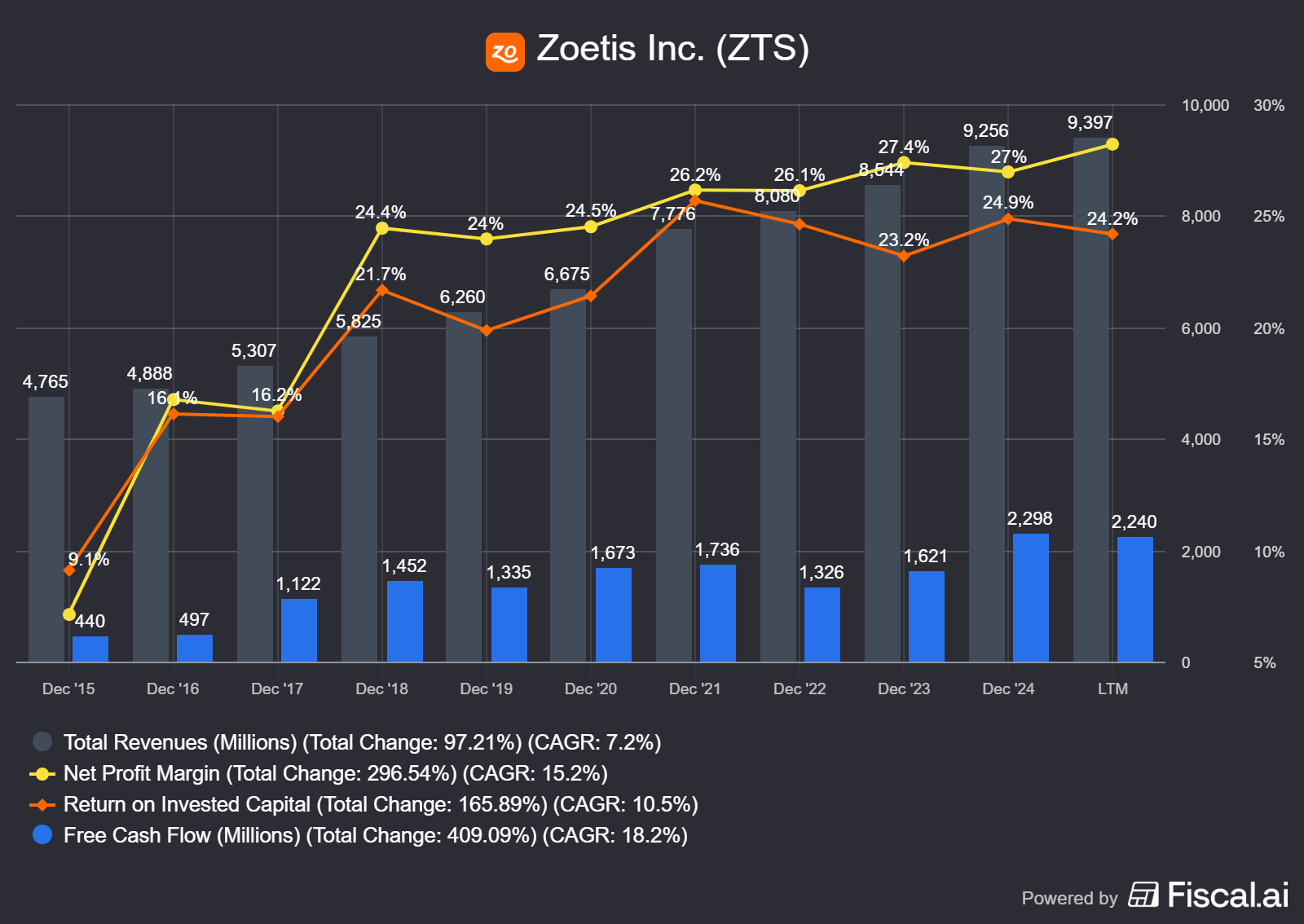
Step 1: Start with Fiscal.ai (30 minutes) Pull up Zoetis and review 5 years of financial statements. Export key metrics:
Revenue: Growing 6-8% annually
Net margins: Stable around 26-27%
FCF: $2.3B in 2024 (strong conversion)
ROIC: Calculate using their invested capital base
Step 2: Use Claude for business understanding (20 minutes) Ask Claude to explain:
How the animal health industry works
Zoetis’s competitive advantages
Key products and their patent protection
Calculate important ratios from the numbers you pulled
From this research, we learn Zoetis operates in a durable, growing industry (pet ownership increasing, protein demand growing) with high switching costs (vets trust their products) and strong brands.
Step 3: Search Bamsec for specific concerns (20 minutes) Search for:
“Patent expiration” – understand revenue at risk
“Competition” or competitor names – gauge competitive intensity
“Acquisition” or “integration” – understand M&A strategy
Any legal or regulatory concerns
This reveals that while some older products face generic competition, Zoetis continues to launch new, protected products.
Step 4: Review Quartr earnings calls (30 minutes) Listen to the latest 1-2 earnings calls, focusing on:
Management’s tone and confidence
How they address challenges (China slowdown, generic competition)
Capital allocation priorities (dividends, buybacks, M&A)
Forward guidance and expectations
Zoetis management typically demonstrates confidence, provides specific product performance metrics, and allocates capital in a disciplined manner.
Step 5: Synthesize with Claude (15 minutes) Ask Claude: “Based on what I’ve learned about Zoetis, what are the key investment merits and risks? Help me organize my thoughts.”
This helps you step back and see the big picture before making a decision.
Total time: About 2 hours
That might sound like a lot, but compare it to the alternative: either spending days manually digging through documents or making a decision based on superficial information. Two hours of focused research with the right tools yield genuine insights.
Now, let’s look at what we learned about Zoetis:
Business Quality: Strong ✓
Leading market position in animal health
Diverse product portfolio (no single product >10% of revenue)
Switching costs and brand loyalty
Growing end markets (companion animal spending, protein demand)
Financial Health: Excellent ✓
Consistent revenue growth (6-8% annually)
High profitability (27% net margins)
Strong cash generation ($2.3B FCF in 2024)
Manageable debt levels
High returns on capital
Management Quality: Good ✓
Clear strategy and execution
Returning $2.6B to shareholders in 2024
Investing in R&D ($686M in 2024, 7.4% of revenue)
Transparent communication
Valuation: Requires Analysis At this point, you’d calculate current multiples:
Current stock price (check latest quote)
P/E ratio vs historical range
FCF yield
Comparison to peers
Risks: Manageable
Patent expirations on older products (offset by new launches)
China market exposure
Regulatory requirements
Competition from generics
Economic sensitivity (though animal health is relatively resilient)
Not too hard, was it?
Investor Takeaway
The difference between mediocre returns and excellent returns often comes down to the quality of your research. These four tools – Fiscal.ai, Bamsec, Quartr, and Claude – help you conduct institutional-grade fundamental analysis from your laptop or phone.
Remember that tools remain just that: tools. They make the work easier and faster, but they don’t replace judgment. You still need to think critically, understand what you’re reading, and make your own decisions.
Here’s how to get started:
For beginners:
Start with Fiscal.ai to understand financial statements visually
Use Claude to explain concepts you don’t understand
Gradually add Quartr and Bamsec as you get more comfortable
For intermediate investors:
Use all four tools in combination
Build a standardized checklist (like the one in this article)
Track what works and refine your process
The bottom line remains: Great investing requires doing the work. These tools don’t eliminate the need for research – they amplify your ability to research effectively.
A final thought: when you’re analyzing a company like Zoetis, you’re not just looking at numbers. You’re evaluating whether this business can compound value over 5, 10, or 20 years. That requires understanding the business deeply. These tools help you get there.
The more you use them, the better you’ll get at spotting great companies and avoiding mediocre ones. And that skill – the ability to analyze businesses thoroughly – remains one of the most valuable skills any investor can develop.
With that, we will wrap up our discussion today. As always, thank you for taking the time to read today’s post, and I hope you find something of value in your investing journey. If I can further assist, please don’t hesitate to reach out.
Until next time, take care and be safe out there,
Dave
Super helpful rundown of the tool stack. The Zoetis walkthru shows how much faster due diligence gets when youre not ctrl+f'ing through 200 page PDFs. One thing I'd add is that Fiscal.ai's auto-calculations are clutch for spotting margin compression trends early, beofre the narrative catches up in earnings calls.